How to secure your shed, garage and outbuildings
Practical ways to secure garden sheds, garages, workshops and farm outbuildings: padlocks, hasps, garage door locks, ground anchors, marking and lighting.
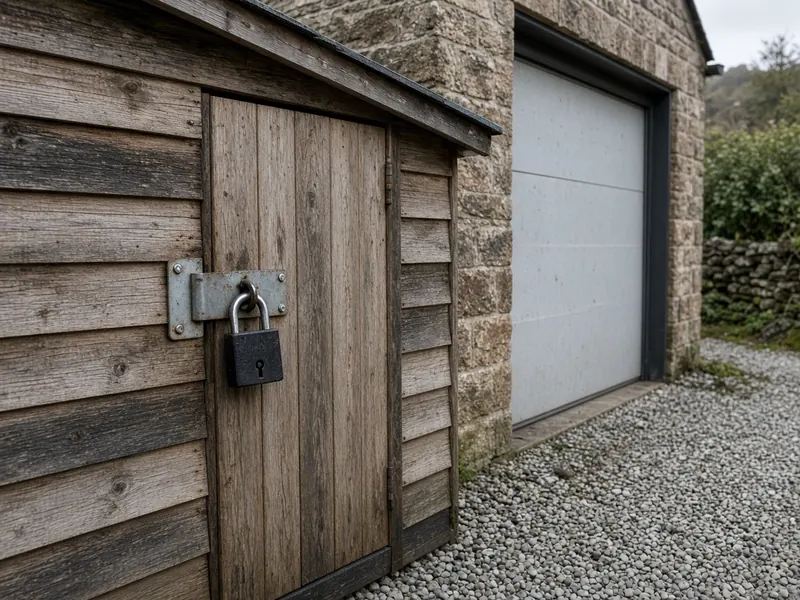
Sheds and garages often hold thousands of pounds’ worth of bikes, tools and garden machinery behind a door secured by a cheap padlock and a few short screws. They’re also where a burglar may find the ladder, crowbar or spade to break into the house. Securing outbuildings protects both what is inside them and the home itself.
Start with the door
Most shed break-ins don’t involve picking a lock. The thief simply levers off the hasp and staple or unscrews the hinges.
- Use a strong hasp and staple, ideally one where the fixings are hidden when the padlock is closed.
- Fix with coach bolts right through the door, with large washers or a backing plate on the inside, rather than wood screws.
- Secure the hinges. Replace exposed screws with coach bolts or one-way security screws.
- Add a second locking point near the bottom of the door, so it can’t be prised open at the corner.
- Strengthen thin doors with a timber batten across the inside.
Choose the right padlock
Not all padlocks are equal:
- Closed-shackle padlocks, where the shackle is shielded by the lock body, are much harder to cut with bolt croppers.
- Look for an independent rating such as Sold Secure, which has Bronze, Silver, Gold and Diamond grades for padlocks, or the CEN grades of the European padlock standard.
- Match the padlock to the hasp. A strong padlock on a flimsy hasp only moves the weak point.
- Keyed-alike padlocks let one key open every outbuilding on the property, which is handy on farms and smallholdings.
Garage doors
Up-and-over garage doors often rely on a single central lock that can be forced by bending a corner of the door. Improvements include:
- a garage door defender, a floor-mounted steel bar that locks across the front of the door
- additional side locks or bolts on the inside
- servicing or replacing a worn central lock and handle
- for roller doors, a floor lock and checking that the motor can’t be easily overridden from outside
If your garage connects to the house, the internal door should be as secure as an external one.
See garage door locks.
Windows in sheds and garages
Windows let thieves see what’s inside, and many can be removed easily.
- Fit frosted film or blinds so equipment isn’t on show.
- Screw or lock shed windows that don’t need to open.
- Consider internal grilles or mesh for workshops with valuable equipment.
Inside the shed: lock things to the building
A determined thief may get through the door, so make the contents hard to carry off:
- Ground anchors set into concrete, with a heavy chain, for bikes, motorbikes, quad bikes and ride-on mowers.
- Wall anchors for bikes.
- Lockable tool chests, bolted down.
- Lock ladders horizontally to a wall with a chain and padlock.
Mark and record
- Postcode-mark tools and equipment with a UV pen, engraving or a forensic marking kit.
- Photograph valuable items and record serial numbers, makes and models.
- Register bikes on a recognised bike register.
Marked items are harder to sell, and recovered items can be returned to you.
Lighting and alarms
- PIR security lights over shed and garage doors.
- Battery-powered shed alarms, which are inexpensive and loud.
- Driveway sensors that alert you when someone approaches, useful on long rural drives.
- CCTV if you have very valuable equipment.
Farm and rural outbuildings
On farms and smallholdings across Moray, outbuildings hold quad bikes, trailers, power tools, fuel and chemicals. Extra steps include:
- locking fuel tanks and keeping chemical stores secure
- locking yard gates, capping hinge pins so gates can’t be lifted off, and blocking access to fields
- removing keys from vehicles and machinery, and keeping them locked away from the vehicles themselves
- joining a farm watch or rural crime scheme
Read the rural home security checklist.
Quick wins for a weekend
If you only have an afternoon and a modest budget, these give the biggest improvement:
- Replace a cheap padlock with a closed-shackle one.
- Swap hasp and hinge screws for coach bolts or security screws.
- Cover shed windows so nothing valuable is on show.
- Chain the ladder and the most valuable item, such as a bike or mower, to something solid.
- Put a battery PIR light over the door.
- Mark your tools with your postcode.
Insurance
Check your home insurance for outbuilding cover limits. Many policies limit cover for items in sheds and garages, and may require the outbuilding to be locked, sometimes with a particular type of lock. Some also exclude bikes or tools above a certain value unless specified.
Key points
Most shed and garage thefts are about weak fixings rather than clever lock-picking. Use a strong hasp fixed with bolts, a closed-shackle padlock, extra locking points, ground anchors and lighting, and mark everything. If you’d like advice or a lock fitted, Moray Locksmith can help.
Frequently asked questions
What is the best padlock for a shed?
A closed-shackle padlock with an independent security rating, paired with a strong hasp fixed with coach bolts.
Is my shed covered by home insurance?
Often, but with limits and conditions. Check the policy for outbuilding limits and any lock requirements.
Can you secure an up-and-over garage door?
Yes. Common upgrades include a garage door defender, extra internal locks, and replacing a worn central lock.
This guide is general information for homes in Scotland. It is not legal or insurance advice. Always check your own policy, tenancy agreement and official guidance.